
Discover more about the
corporate history of thyssenkrupp
On November 20, 1811, Friedrich Krupp (1787-1826), member of an old Essen family of merchants, and two partners found a factory for the manufacture of English cast steel and products made from this steel. From 1816 as sole proprietor he manufactures high-quality cast steel which he uses to produce tanner's tools, coining dies and coin blanks.
Following his untimely death, his widow, Therese Krupp (1790–1850), continues to run the small business with a handful of employees, helped by her then 14-year-old eldest son Alfred (1812–1887). He continues with the production of cast steel, but shifts manufacturing operations toward finished products, primarily precision rolls for which he provides a guarantee of quality. After import duties are lifted, sales are expanded abroad.
From 1850, Alfred Krupp as sole proprietor succeeds in expanding the business into an important steel company. The advent of the railways opens up new applications for Krupp's durable cast steel. Alongside axles and springs, these include above all the seamless and thus fracture-proof railway tires developed by Alfred Krupp.
In 1875, Krupp chooses three superimposed railway tires as his company logo, which becomes known throughout the world. In 1859, he breaks into artillery production with an order from the Prussian military authorities for 300 gun barrel ingots.
Through extensive traveling, the establishment of representative offices, and participation in world exhibitions, the company develops new markets all over the world. Steel production is made profitable by the early introduction of new production methods such as the Bessemer process (introduced in 1862) and the open hearth process (1869).
Alfred Krupp meets the company's rapidly growing raw materials requirements by acquiring ore and coal mines and steel mills. In 1862, he appoints an accountable management board.
His only son Friedrich Alfred Krupp (1854–1902) continues to expand the company into a vertically and horizontally integrated enterprise.
The acquisition of the Grusonwerk in Magdeburg in 1892/93 lays the foundations for Krupp's plant construction activities, while the takeover of Schiff- und Maschinenbau AG Germania in Kiel in 1896/1902 provides access to the shipbuilding sector. The group's pig iron and steel base is expanded in 1897 with the integrated iron and steel mill in Rheinhausen.
Bertha Krupp (1886–1957), the elder daughter of Friedrich Alfred Krupp, is sole heiress to the company upon her father's death. On the basis of a testamentary recommendation, the company is converted to a stock corporation in 1903. With the exception of four shares as required by law, the stock remains in the possession of the heiress. After marrying Bertha Krupp in late 1906, Gustav Krupp von Bohlen und Halbach (1870–1950) is made deputy chairman, then from 1909 to 1943 chairman of the supervisory board of Fried. Krupp AG. The expansion of the company continues. In 1912, stainless, acid-resistant steel grades are developed, which quickly find use in a variety of applications. The NIROSTA and V2A brands are still well known today.
During the First World War, armaments production increases to more than five times the pre-war level to meet government orders. After the end of the war, the Treaty of Versailles forbids the production of arms almost completely.
Dismantling and production changeovers cause problems for Krupp, exacerbated by the general political and economic situation (occupation of the Ruhr, inflation). It takes many years before success is again achieved in the newly added production operations, e.g. the construction of locomotives, trucks, agricultural machinery and excavators. The group is stabilized by streamlining the manufacturing operations and expanding stainless steel production. In 1926, Krupp launches WIDIA carbide, representing a significant advance in tooling technology thanks to its hardness and wear resistance.
After 1933, Krupp is tied closely to the economic policies of the National Socialist regime. Increased demand for rolling mill products, primarily for highway construction, results in the expansion of the structural engineering shops in Rheinhausen. The construction of locomotives, trucks and ships is stepped up. In parallel with this, Krupp resumes arms production.
At the end of 1943, Fried. Krupp AG is converted back to a sole proprietorship and transferred to the eldest son Alfried Krupp von Bohlen und Halbach (1907–1967). He takes over the company at a time when intervention in production by munitions authorities and semi-private control bodies is on the increase.
At the end of the war, large parts of the production facilities are destroyed, while other parts, such as the modern steel mill in Essen-Borbeck, are dismantled. The Grusonwerk plant is expropriated by the victorious Allies, the Germaniawerft shipyards are lost to destruction and subsequent dismantling.

In late 1953, Alfried Krupp von Bohlen und Halbach appoints Berthold Beitz (1913–2013) as his personal chief executive. From then on, Beitz plays a major part in setting company policy, which is initially restricted to the manufacturing operations; the steel mills and mines belonging to the Krupp company are sequestered and placed under a divestment order by the Allies. The company thus no longer has its raw materials and vital steel base.
In the subsequent years, the remaining manufacturing operations form the basis of a restructured group. The product range is made as broad as possible in an attempt to make the company crisis-proof and secure job continuity. Added to this come the industrial plant operations, for whose products new sales markets are developed from the mid-1950s in the Eastern Bloc states and industrializing nations. In 1960, Krupp combines the remaining coal and steel operations and expands this basis by merging with Bochumer Verein für Gussstahlfabrikation AG, in which a majority interest had been acquired in the late 1950s. The Krupp plant opened in Brazil in 1961 supplies drop forgings for engines and motor vehicles. Greater emphasis is also placed on mechanical engineering, e.g. by acquiring a majority interest in Atlas-Werke AG with MaK Maschinenbau GmbH.
Alfried Krupp von Bohlen und Halbach dies in July 1967. After his death, the divestment order, which has only been fulfilled to a very limited extent, expires. In accordance with his last will and testament, and after his son Arndt (1938–1986) has renounced his inheritance, the non-profit Alfried Krupp von Bohlen und Halbach Foundation as his heir converts the company into Fried. Krupp GmbH, which is officially registered on January 2, 1968.
The coal mines are separated from the group in 1969 and transferred to Ruhrkohle AG. In the subsequent years, all the company's divisions undergo targeted expansion through organic growth and the acquisition of several important interests in the plant construction sector.
The acquisition of a majority interest and subsequent takeover of Stahlwerke Südwestfalen AG provides for expansion in the stainless steel sector. By purchasing VDM Nickel-Technologie, the Group incorporates one of the world's leading suppliers of high-performance materials. In the period 1980 to 1983, Fried. Krupp GmbH spins off all its operating activities and is restructured into a purely management holding company. The acquisition of a majority interest in Hoesch AG in Dortmund is followed by its merger with Fried. Krupp AG – the name under which the former Fried. Krupp GmbH has traded since March 1992.
The new company Fried. Krupp AG Hoesch-Krupp is entered in the Essen and Dortmund commercial registers in December. In the subsequent years, the activities of the expanded group are reorganized. Key objectives are greater closeness to customers, enhanced market presence, concentrating on core businesses and the utilization of merger-related synergies.
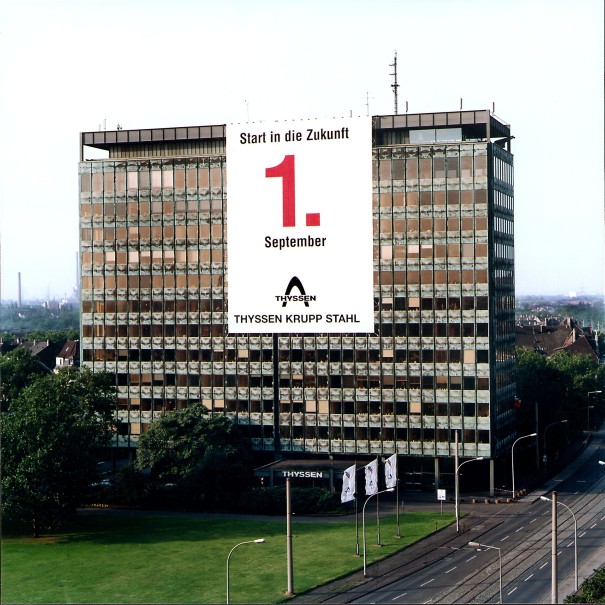
The merger of the Thyssen and Krupp steel operations at September 1, 1997 was clearly displayed on the head office of the new company.
As early as the 1980s negotiations are conducted on a merger of Krupp Stahl AG and Thyssen Stahl AG. Although the proposed alliance cannot be realized in 1983, the two companies cooperate closely in selected Business Areas.
In 1997 the two groups' flat steel activities are combined to form Thyssen Krupp Stahl AG.
In August 1997 Krupp and Thyssen hold talks on expanding their cooperation. They identify immense potential for strategic development and operating synergies in a full merger. This then takes place on March 17, 1999, when Thyssen Krupp AG is entered in the Commercial Register.