
Discover more about the
corporate history of thyssenkrupp
From 1883 August Thyssen purchased share certificates in Gewerkschaft Deutscher Kaiser as the plant was (and still is) ideally located for his business plans.
With its own coal mine, works dock on the River Rhine and link to the railway network, the location ensures the productivity of the operations.
On September 29, 1891 August Thyssen announces that he and his brother Joseph own all shares in the coal mine Gewerkschaft Deutscher Kaiser.
Shortly after, on December 17, 1891, the first steel is tapped at the new Gewerkschaft Deutscher Kaiser steelworks in Hamborn near Duisburg. The main plant of Thyssen Krupp Stahl AG still produces steel at this location today.
These two events in 1891 are later regarded as the dates on which the Thyssen Group was founded.
In the following years August Thyssen rationalizes, modernizes and enlarges the production of iron and steel and systematically expands both the raw materials base (foreign ore mines) and the manufacturing operations (shipbuilding, machine casting etc.) of his companies. He ensures that the products of the newly acquired or established companies fit together well to form a vertically integrated group.
Left: August Thyssen, c. 1917 (painting by Franz Josef Klemm); right: Joseph Thyssen, brother and close confidant of August Thyssen, c. 1900.
In the first decade of the 20th century, individual holding functions of the firm of Thyssen & Co., founded by August Thyssen in Mülheim an der Ruhr in 1871, are gradually transferred to Gewerkschaft Deutscher Kaiser, where his son Fritz (1873–1951) is elected to the mining board in 1897.
The internationalization of the group in the early part of the 20th century is brought to an abrupt halt by the onset of the First World War. After an initial sharp decline, production is then expanded to support the war effort, followed in the immediate post-war period by fear of socialization and, in 1923, the French occupation of the Ruhr region. Although August Thyssen loses numerous foreign interests after the First World War, in Germany his company is still largely intact.
The potential for rationalization and market opportunities convince him, in 1925, to agree in principle to the establishment of a new group comprising all iron and steel companies in the Ruhr with the exception of Hoesch, Gutehoffnungshütte, Mannesmann, Klöckner and Krupp.
A few weeks after August Thyssen's death on April 4, 1926, large parts of the Thyssen group are transferred to Vereinigte Stahlwerke AG. His son Fritz Thyssen is appointed supervisory board chairman of the new group. Thyssen's stake in the newly established Vereinigte Stahlwerke AG, whose share capital totals 800 million reichsmarks, is valued at 26%.
August Thyssen-Hütte AG is founded in 1934 as an operating company of Vereinigte Stahlwerke AG. It is a horizontally integrated enterprise comprising the five iron and steelworks of Vereinigte Stahlwerke AG in the Duisburg area and focuses on the production of sectional steel and semi-finished products. Under the National Socialist rearmament policy, these plants are an important supplier of preliminary products for the subsequent war economy. On Allied orders, the company is liquidated after the war, and in 1953 a new August Thyssen-Hütte AG is established in Duisburg with the sole purpose of putting the largely dismantled Thyssen iron and steelworks back into operation.
The other Duisburg-based iron and steelworks of Vereinigte Stahlwerke AG initially go it alone as legally independent companies before returning to the Thyssen group in the 1950s and 1960s. Only the Thyssen mining company transferred to Vereinigte Stahlwerke AG in 1926 does not return to the old group.
In the 1950s and 1960s, August Thyssen-Hütte AG expands into a steel group. In 1954/55, August Thyssen-Hütte AG initially concentrates on acquisitions in the vertically upstream mining and rock products industries to restore its raw materials base. Subsequent horizontal diversification is effected by acquiring majority interests in Niederrheinische Hütte AG (1956), Deutsche Edelstahlwerke AG (1957), Phoenix-Rheinrohr AG Vereinigte Hütten- und Röhrenwerke (1964) and Hüttenwerk Oberhausen AG (1968).
Celebration at the Thyssen-Hütte on May 7, 1951 as the first blast furnace is restarted after the war. In the foreground the oldest blast furnace worker in the workforce at the time.
The group's range takes in sectional and flat products in all grades through to high-alloy stainless steel; rationalization gains are made by mutually coordinating production operations. In parallel, the iron and steel mills, which had been regarded as optimally sized, were rapidly enlarged.
By the mid 1960s, August Thyssen-Hütte AG is Europe's biggest producer of crude steel and ranks number five worldwide. In addition to horizontal diversification, from 1960 a trading organization, Handelsunion AG, is added which in 1969 is renamed Thyssen Handelsunion AG. In the decades that follow, Thyssen Handelsunion AG evolves from an exclusive steel trader into a versatile service provider, concentrating by the mid 1990s on its core businesses materials, industrial and facility services, and project management.
The final phase of horizontal diversification at August Thyssen-Hütte AG leads to specialization through cooperation. In 1969 Mannesmann AG and August Thyssen-Hütte AG agree to a division of responsibilities, summed up in the phrase "tubes for Mannesmann, rolled steel for Thyssen".
By the end of the 1960s, August Thyssen-Hütte AG is a monostructured steel group. It starts to change direction in 1973 with the acquisition of Rheinstahl AG, whose operations focus on manufacturing. This takeover reduces August Thyssen-Hütte AG's dominance in the steel sector and it becomes a conglomerate.
The broad-based activities of Rheinstahl AG are combined with the corresponding Thyssen businesses in the four newly formed divisions Capital Goods and Manufactured Products, Trading and Services, Stainless Steel and Steel. Consequently, August Thyssen-Hütte AG changes its name in 1977 to Thyssen Aktiengesellschaft vorm. August Thyssen-Hütte. To document the fact that Rheinstahl AG now represents the manufacturing division of the Thyssen Group, it is renamed Thyssen Industrie AG in 1976.
The steel division is spun off into Thyssen Stahl AG effective April 1, 1983; from then on, Thyssen Aktiengesellschaft, former August Thyssen-Hütte, concentrates exclusively on group management functions.
In the years that follow, the Thyssen Group adapts its steel production to market conditions and carries out structural adjustments. To concentrate its activities, the Thyssen Group defines core business areas in 1996 and undertakes a portfolio streamlining. The focus on selected business areas with strong market and earnings potential simultaneously serves to further the Group's internationalization.
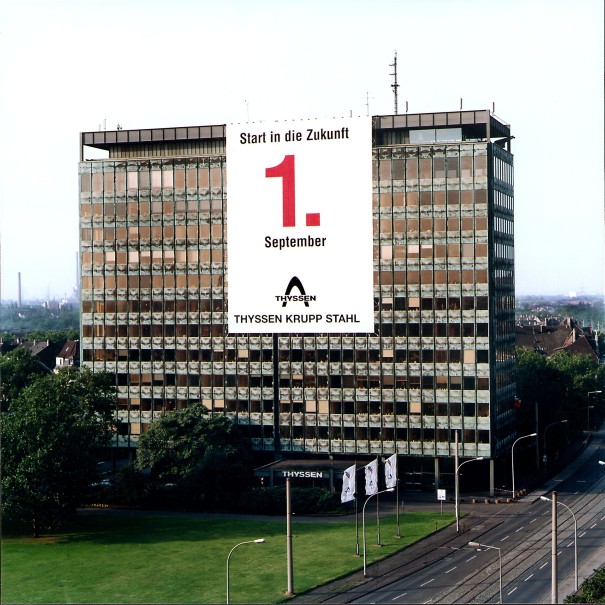
The merger of the Thyssen and Krupp steel operations at September 1, 1997 was clearly displayed on the head office of the new company.
As early as the 1980s, negotiations are conducted on a merger of Thyssen Stahl AG and Krupp Stahl AG. Although the proposed alliance cannot be realized in 1983, the two companies cooperate closely in selected business areas. In 1997, the two groups' flat steel activities are combined to form Thyssen Krupp Stahl AG.
In August 1997, Thyssen and Krupp hold talks on expanding their cooperation. They identify immense potential for strategic development and operating synergies in a full merger. This then takes place on March 17, 1999, when Thyssen Krupp AG is entered in the Commercial Register.